Does virtual reality exposure therapy for fear of dogs really work?
What if you could overcome your fear of dogs without ever having to meet one?
Exposure therapy is well-established as the gold standard treatment for phobias, with a large body of research showing that it's highly effective, fast-acting, long-lasting and superior to other approaches.1–4
But many people with cynophobia find the thought of an encounter with a real dog too overwhelming — or they simply don't know how to get started.
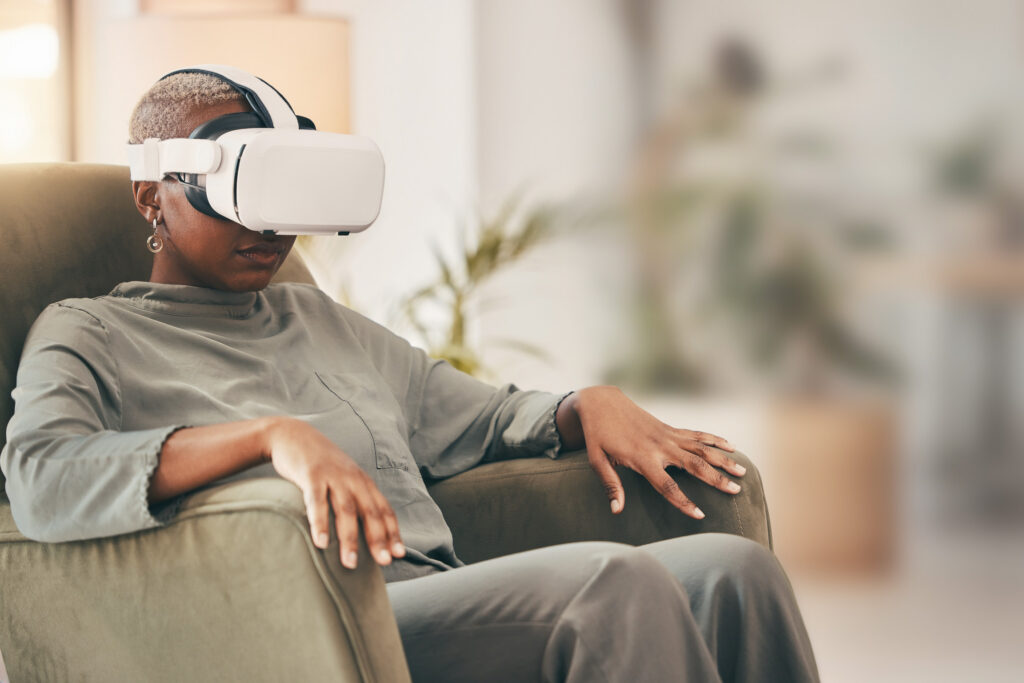
Virtual reality (VR) gives people with a phobia of dogs the option to do exposure therapy from the comfort and safety of the therapy room (or even their own home).
But what exactly does it involve, and is it really an effective alternative to the real thing?
[contents]
What is VR exposure therapy?
VR exposure therapy is a relatively new method of delivering a tried-and-tested treatment for phobias, in which you approach your fear through a lifelike video, viewed on a virtual reality headset.
At The Cynophobia Clinic, we use a clinical VR platform built on 360° videos of real dogs, filmed in everyday settings. It isn't a game, and the dogs aren't animated. Because they're real dogs, they move, sound and behave the way dogs actually do — including the body language that tells you how a dog is feeling and what they're likely to do next.
The scenes cover a wide range of settings and different behaviours, so that they can be graded from easier to harder according to each client's triggers. An early scene might show a calm dog on a lead some distance away. Later scenes bring dogs closer and show them more active.
Even though you understand that the dogs you see are just images on a screen, the immersive nature of the experience is still sufficient to trigger some feelings of anxiety for many people with a phobia of dogs.
During the sessions, your psychologist guides you through each scene, helps you decide on the next step, and coaches you to deal with the thoughts and feelings that show up along the way.
As with any exposure therapy, the aim isn't to make the fear vanish in the moment. It's to give your brain new experiences that update what it has learned about dogs.
Why start with a virtual dog?
Your fear alarm doesn't take instructions, but it does learn. Exposure therapy works by giving it positive new experiences that compete with what it learned before.5 VR offers a few practical advantages for getting that learning started.
A gentler first step. For many people, the hardest part of treatment is the thought of coming face-to-face with a real dog. Starting with a virtual dog puts the first step lower on the ladder, so that getting started actually feels possible.
You stay in control. You can pause a scene, repeat it or take the headset off whenever you choose. Knowing you can stop at any time often makes it easier to keep going, and knowing exactly what to expect means you know what you're saying yes to.
Practising the hard moments. Some of the situations people fear most, like a dog running towards them or barking, are difficult to arrange with a real dog — and hard to put on repeat. In VR, these moments can be practised as many times as needed, without involving a real animal.
Flexibility. Sessions can take place in the clinic — or even in your own home using your smartphone and a VR headset we supply — which can make it easier to fit treatment into your life.
What does the research say?
VR exposure therapy is well supported for phobias in general, but the research suggests it works best as a first step towards real dogs rather than a full replacement.
VR for phobias. Reviews combining many clinical trials have found that VR exposure therapy works about as well as real-life exposure for specific phobias.6,7 Importantly, the improvements carry over to real situations, not just virtual ones.8 One difference is speed: in one of the larger trials, for spider phobia, real-life exposure brought faster improvement in the first week, although VR caught up over the following months.11
Why VR can work. Exposure therapy works best when it gives your brain experiences that don't match what it expects — the dog doesn't lunge, the barking passes, you cope — across lots of different dogs and situations.5 VR makes it easy to vary the size and type of dog, what it's doing and where. It also doesn't need to be perfectly realistic. In animal phobias, how 'present' people feel in a virtual scene is closely linked to how much fear it brings up,12 and that is what provides something new to learn.
VR for fear of dogs. Research specific to dogs is still limited. The strongest study so far comes from Griffith University in Queensland. Children with a phobia of dogs had a single extended VR session using 360° video of six real dogs of different breeds, with parents joining towards the end, followed by three weeks of phone-supported practice with real dogs.9 A month later, most were able to pat a live dog — a different dog from those in the videos, which suggests the learning carried over to real life. The children rated the videos as only a little like real life, yet this didn't stop the treatment working. It was a small study, though, with eight children and a short follow-up.
A New Zealand trial of a self-guided smartphone VR program, which included adults with a fear of dogs, found it reduced phobia symptoms compared with waiting for treatment.10 That program was used without a therapist, and results weren't reported separately for dogs. At the clinic, VR sessions are guided by a psychologist.
Autistic young people. Studies of an immersive 'Blue Room', where personalised scenes are projected onto the walls rather than viewed through a headset, have found that VR exposure helped some autistic children and young people face specific fears, including fear of dogs.13 Being in control of the pace was a central part of the approach.
Real dogs on screen. A review of the virtual dogs used in research found that most studies used a single breed, and that the dogs' behaviour often wasn't based on how dogs actually behave.14 That matters, because part of overcoming a fear of dogs is learning to read what a dog is communicating. Using video of real dogs means the body language you learn from is genuine.
So can VR replace the real thing? Not entirely, although it offers genuine benefits. It's easier to start, you stay in control of every step, it doesn't depend on finding the right dog and handler, and it can be done from home.
The results so far are promising, but no large study has yet compared VR with real-dog exposure for fear of dogs. There is also a limit that no video can overcome: real dogs respond to what's happening around them, including to you. That is one of the most challenging parts of a fear of dogs, and an on-screen dog can't replicate it. Real-life exposure remains the most effective form of exposure therapy overall.1
That's why we use VR as a stepping stone: a gentle way to get started, with real dogs still the place where new learning counts most. VR lets you build confidence at your own pace, so that when you do meet a real dog, the step is smaller than it would otherwise have been. Whether and when you take that step is always your choice.
How it works at The Cynophobia Clinic
VR is an optional first step for clients who aren't ready to begin exposure therapy with a real dog. In practice, the process usually looks like this:
Roadmap session. A 90-minute telehealth consultation. We talk through your fear, what you want to be able to do, and consider whether starting with VR is right for you.
Creating your plan. Together we map out the steps from where you are now to where you want to be, including which virtual scenes to start with.
Guided VR sessions. In the clinic using a VR headset, or at home on your smartphone using a headset we supply, guided by your psychologist over telehealth. You move through the scenes at a pace you're comfortable with.
Exposure therapy with a real dog. When you're ready, a calm, predictable dog, on lead, handled by someone you trust, at a distance you choose.
Generalising to everyday life. Different dogs, different behaviours, different scenarios — putting what you've learned into practice in a way that gives you genuine confidence to handle real-life situations.
You're never pushed into a scene or a situation you don't feel ready to enter, and your consent is sought at every stage. This case study of a lifelong fear of dogs describes what the later stages of the process can look like.
VR sessions cost the same as our regular telehealth consultations and have the same Medicare rebate eligibility. See funding and rebates for details.
Is VR right for you or your child?
VR exposure therapy may suit you if:
- the thought of being near a real dog has stopped you from starting treatment
- you've tried meeting dogs before and it felt overwhelming
- a bad experience with a dog makes the idea of meeting a real dog especially daunting
- you'd like to get a feel for exposure therapy before working with a real dog
- you can't come to the clinic in person, and it's hard to find a suitable dog to practise with where you live.
Children. VR is usually suitable from about age 6, depending on the child. We'll help you decide whether it suits your child and how you can be involved. For ideas on supporting your child at home, see 11 things you can do to help your child overcome a fear of dogs.
Autistic and other neurodivergent people. Many autistic people find that predictability is important for feeling safe. VR offers a starting point where you know what's coming and decide what happens next. It also lets you watch how dogs behave as many times as you need, so that real dogs feel more familiar when you meet them. Read more about why an autistic child's fear of dogs makes perfect sense.
When VR may not suit. For some people, a virtual dog just doesn't bring up enough fear to make meaningful learning possible. If that's the case, we'll help you find a manageable starting point with a real dog. VR can also cause dizziness or queasiness, and headsets may not be suitable for people with certain medical conditions, such as photosensitive epilepsy. If any of these apply to you or your child, we'll work out the best way forward at your Roadmap session.
Common questions
Will it feel real? It doesn't need to feel exactly like the real thing to help. What matters is that it feels real enough to bring up some fear, so there is something new to learn.
How is this different from watching videos of dogs online? The 360° video surrounds you, so it feels much more immersive. The scenes are graded step by step, and your psychologist guides each one, helping you test what you expect to happen and notice what actually does.
Can I stop at any time? Yes. You can pause a scene or take the headset off whenever you choose.
Can I do it from home? Yes. Home sessions use your smartphone and a VR headset we supply, with your psychologist guiding you over telehealth.
Can I use VR on my own, without a psychologist? Self-guided VR can be effective for some people,10 but exposure is hard to keep up alone.15 A psychologist tailors each step to you, spots subtle avoidance that can stall progress, teaches you skills for handling anxiety when it shows up, and helps you make sense of the dogs' behaviour so you're ready for the move to real dogs.
How many VR sessions will I need? It depends on your fear and your goals. Some people move on to real dogs after a few sessions, and others prefer to spend longer with VR first. We'll plan this together and adjust as you go.
Will I have to meet a real dog eventually? Only if you choose to. Most people's goals involve real dogs, so most plans include that step — but when, and whether, you take it is up to you.
Can I claim a Medicare rebate? VR sessions have the same rebate eligibility as our other sessions. See funding and rebates.
VR exposure therapy lets you start overcoming a fear of dogs using 360° video of real dogs, guided by a psychologist, in the clinic or at home. It offers an easier first step, with you in control of the pace, and lets you practise situations that are hard to arrange with a real dog.
Research on VR for phobias is encouraging, with results broadly comparable to real-life exposure. Evidence specific to dogs is still limited, though, and an on-screen dog can't respond to you the way a real one does.
At The Cynophobia Clinic, VR is a stepping stone: a way to build confidence and new learning before meeting real dogs, if and when you choose. It may particularly suit people who haven't been able to start treatment because the thought of a real dog felt like too much.
References
- Wolitzky-Taylor, K. B., Horowitz, J. D., Powers, M. B., & Telch, M. J. (2008). Psychological approaches in the treatment of specific phobias: A meta-analysis. Clinical Psychology Review, 28(6), 1021–1037.
- Choy, Y., Fyer, A. J., & Lipsitz, J. D. (2007). Treatment of specific phobia in adults. Clinical Psychology Review, 27(3), 266–286.
- Odgers, K., Kershaw, K. A., Li, S. H., & Graham, B. M. (2022). The relative efficacy and efficiency of single- and multi-session exposure therapies for specific phobia: A meta-analysis. Behaviour Research and Therapy, 159, Article 104203.
- Hauner, K. K., Mineka, S., Voss, J. L., & Paller, K. A. (2012). Exposure therapy triggers lasting reorganization of neural fear processing. Proceedings of the National Academy of Sciences, 109(23), 9203–9208.
- Craske, M. G., Treanor, M., Conway, C. C., Zbozinek, T., & Vervliet, B. (2014). Maximizing exposure therapy: An inhibitory learning approach. Behaviour Research and Therapy, 58, 10–23.
- Wechsler, T. F., Kümpers, F., & Mühlberger, A. (2019). Inferiority or even superiority of virtual reality exposure therapy in phobias? A systematic review and quantitative meta-analysis on randomized controlled trials specifically comparing the efficacy of virtual reality exposure to gold standard in vivo exposure in agoraphobia, specific phobia, and social phobia. Frontiers in Psychology, 10, 1758.
- Carl, E., Stein, A. T., Levihn-Coon, A., Pogue, J. R., Rothbaum, B., Emmelkamp, P., Asmundson, G. J. G., Carlbring, P., & Powers, M. B. (2019). Virtual reality exposure therapy for anxiety and related disorders: A meta-analysis of randomized controlled trials. Journal of Anxiety Disorders, 61, 27–36.
- Morina, N., Ijntema, H., Meyerbröker, K., & Emmelkamp, P. M. G. (2015). Can virtual reality exposure therapy gains be generalized to real-life? A meta-analysis of studies applying behavioral assessments. Behaviour Research and Therapy, 74, 18–24.
- Farrell, L. J., Miyamoto, T., Donovan, C. L., Waters, A. M., Krisch, K. A., & Ollendick, T. H. (2021). Virtual reality one-session treatment of child-specific phobia of dogs: A controlled, multiple baseline case series. Behavior Therapy, 52(2), 478–491.
- Lacey, C., Frampton, C., & Beaglehole, B. (2023). oVRcome – Self-guided virtual reality for specific phobias: A randomised controlled trial. Australian and New Zealand Journal of Psychiatry, 57(5), 736–744.
- Miloff, A., Lindner, P., Dafgård, P., Deak, S., Garke, M., Hamilton, W., … Carlbring, P. (2019). Automated virtual reality exposure therapy for spider phobia vs. in-vivo one-session treatment: A randomized non-inferiority trial. Behaviour Research and Therapy, 118, 130–140.
- Ling, Y., Nefs, H. T., Morina, N., Heynderickx, I., & Brinkman, W.-P. (2014). A meta-analysis on the relationship between self-reported presence and anxiety in virtual reality exposure therapy for anxiety disorders. PLoS ONE, 9(5), e96144.
- Maskey, M., Rodgers, J., Grahame, V., Glod, M., Honey, E., Kinnear, J., … Parr, J. R. (2019). A randomised controlled feasibility trial of immersive virtual reality treatment with cognitive behaviour therapy for specific phobias in young people with autism spectrum disorder. Journal of Autism and Developmental Disorders, 49, 1912–1927.
- Oxley, J. A., Santa, K., Meyer, G., & Westgarth, C. (2022). A systematic scoping review of human–dog interactions in virtual and augmented reality: The use of virtual dog models and immersive equipment. Frontiers in Virtual Reality, 3, 782023.
- Bunnell, B. E., Schuler, K. R., Craggs, J. G., Welch, B. M., & Ong, T. (2026). Examining the efficacy of a telehealth-based virtual reality clinic in treating adults with specific phobia: Feasibility randomized controlled trial. JMIR Formative Research, 10, e84670.

More articles
-

Why your autistic child’s fear of dogs makes perfect sense — and how to help
A fear of dogs is common among autistic children, and it makes sense — dogs are loud, fast and unpredictable, and sensory input doesn’t fade with repetition. How to tell a sensory need from a phobia, what tends to backfire, and what actually helps.
-

Why can’t I control my fear of dogs — even when I know I’m safe?
Being unable to talk yourself out of a fear of dogs isn’t a sign that something is wrong with you. Here’s why the brain’s fear alarm doesn’t take instructions — and what can be changed instead.
-
Signs and symptoms of cynophobia: When a fear of dogs takes control
Many people feel wary around certain dogs — but cynophobia is something more. A look at the diagnostic criteria used to distinguish a common fear from a clinical phobia, and what each one means in everyday life.
-
Overcoming a lifelong fear of dogs: A case study
An illustrative case study showing how graded, in-vivo exposure therapy can treat a severe, long-standing fear of dogs — from initial assessment through to a client walking confidently through an off-leash dog park.
-

Yes, dogs can smell your fear (but it probably doesn’t matter)
Dogs really can detect fear through scent — but research shows this makes them more cautious, not more aggressive. Here’s what the science actually says, and how to behave around a dog if you’re feeling afraid.
-

How to overcome a fear of dogs: What actually works
Cynophobia is a common, treatable specific phobia, and exposure therapy — approaching feared situations gradually and with consent, guided by an experienced clinician — is the most effective, evidence-based treatment available.
-

11 things you can do to help your child overcome a fear of dogs
A fear of dogs is one of the most common childhood phobias. Eleven practical, evidence-informed ways parents can support their child through it, gently and effectively.

Ready to take the first step?
Start with a Roadmap session with Anthony — a 90-minute telehealth consultation you can join from home, anywhere in the world.
Book a Roadmap session