What to do if your child is scared of your new dog
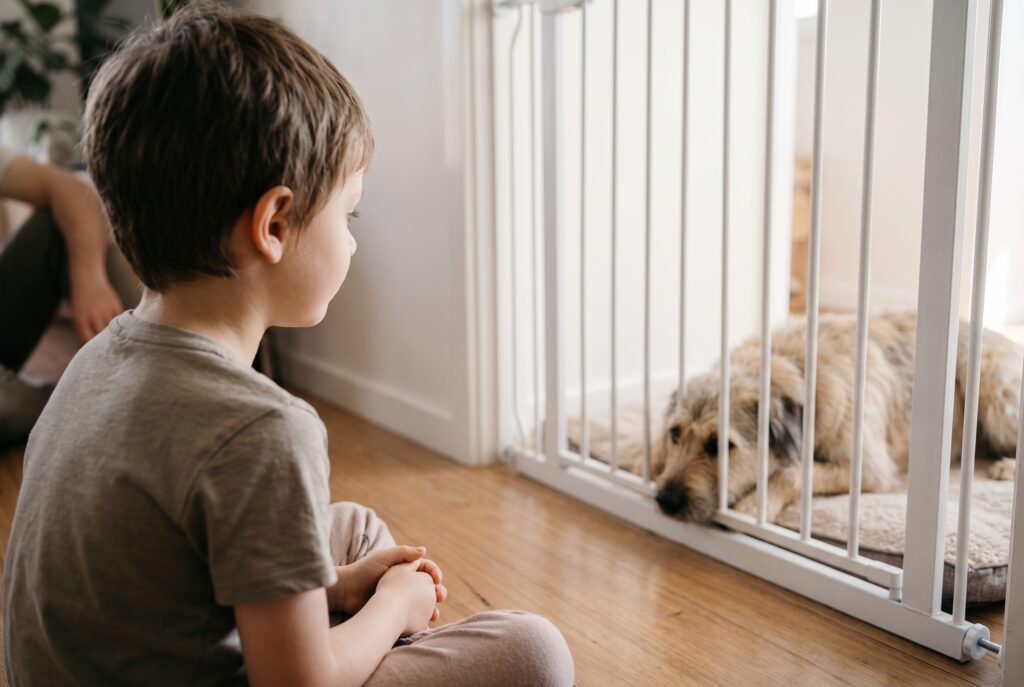
The puppy you've waited months for is finally home. Everyone's excited — except your child, who won't come downstairs.
Will they get used to it? Should you encourage them to pat the dog? And the question many parents are afraid to ask: did we make a mistake?
A dog at home can become one of the best opportunities your child will have to feel safe around dogs. The key is letting your child set the pace.
In this article, we explain how to set up your home and family so everyone can relax, how to build confidence step by step, and what to do if you're wondering whether the dog should stay.
[contents]
Why a new dog can feel overwhelming
To a child who isn't yet confident around dogs, a new dog in the home can make what's supposed to be their safe place feel unpredictable and out of control.
Dogs move fast, bark, jump and lick, and don't wait to be invited to approach. If your child doesn't know what to expect, or how to handle interactions, this can leave them in a constant state of alert.
Fear is the brain's alarm system — it turns on automatically when it perceives a threat, and it can't be switched off at will. At the park, your child can walk away. At home, the dog is there at breakfast and at bedtime.
The aim isn't to talk your child out of their fear. It's to give them back a sense of control in their own home and provide opportunities for them to build confidence through success.
Let your child set the pace
It's natural to want to help your child get over it quickly: telling them to "come and say hello", or holding them on your lap while the dog sniffs them. These attempts come from love, but they tend to backfire. Each time your child is brought closer than they chose, they learn that being near the dog feels scary and they don't have control.
Even when things are going well, pushing can undo progress. In one study, children whose parents were more involved in phobia treatment did just as well at first, but surprisingly were less likely to be phobia-free six months later. The researchers suggested that early success raised parents' expectations, making them less tolerant of their child's avoidance and more likely to push them too far, too fast.1
Instead, let your child decide how close to get, for how long, and when to step back. Your job is to set up the home so those choices are available but never forced. When children know they can say no, they're far more likely to say yes.
Praise bravery, not contact — and don't overdo it
Being brave means being willing to feel the fear and do something anyway — something your child has chosen. Praise the bravery, not contact with the dog. Praising every pat makes contact the goal, and suggests keeping their distance is a failure. Staying in the room or saying "that's close enough" can take just as much courage.
Keep it low-key. Big praise can turn the next step into a test, and children who are unsure of themselves may respond by avoiding the next challenge.2 At worst, a child may push through distress just to please you. That isn't consent, and it tends to strengthen fear.
"Not today" should get the same calm response as stepping forward. Sticker charts carry a similar risk, as rewards can reduce interest in an activity for its own sake.3 If your child feels safe and in control, the interactions they choose will be rewarding in themselves. A brief acknowledgement is plenty: "You stayed on the couch while Biscuit had dinner — that took some bravery."
Your role: what your child sees you do
If your child is scared of the dog you brought home, you might feel guilty, frustrated or worried, or uneasy around dogs yourself. That's normal. Notice those feelings, make room for them, and choose what you do next.
Children learn what's safe by watching trusted adults. Toddlers become more fearful of things their parent reacts to negatively,4 and less likely to fear things they've first seen their parent respond to positively.5
Model the interactions your child would like to have
Let your child watch you interact with the dog calmly and briefly. That includes ignoring it sometimes, which shows that living with a dog doesn't mean constant contact.
It also includes asking the dog to leave you alone. When the dog gets too excited, or you want to say "no" to an interaction, use the magic statue: stand still, fold your arms, stay quiet and look away. Seeing a dog lose interest makes it look far more manageable.
Get the whole family on the same page
Siblings who adore the dog, grandparents who say "she won't hurt you", or a teasing uncle can undo days of progress. Have a family meeting to agree on a few house rules, such as:
- Nobody brings the dog to the child. No calling the dog over or putting the puppy on their lap.
- Nobody teases or tests, such as chasing the child with the dog or laughing about the fear.
- Everyone respects the child's stop signal straight away (see below).
- Safe spaces stay dog-free. No exceptions.
Give siblings a helpful role, like taking the dog outside to play, so the rules don't feel like a punishment. Have a weekly meeting to review the rules, reinforce what's working and change what's not.
Set up your home so everyone can relax
Your child can only feel safe and in control if the home makes that possible:
- Limit where the dog can go, not where your child can go. Use closed doors, baby gates, a playpen or a crate to keep the dog in set areas. Your child should be free to move around the rest of the house, not stuck in their room to feel safe.
- Make unexpected encounters impossible. Your child should never turn a corner and find the dog there. Any time they share a space should be planned and chosen.
- Use barriers your child can see through, like baby gates, so they can watch the dog from a safe distance.
- Keep a predictable routine, so your child knows when and where the dog will be.
- Agree on a stop signal: a word, hand signal or behaviour that your child can use even when they're in a state of panic. When your child uses it, an adult immediately moves the dog away.
Read your dog's signals too
Your dog needs a choice as well. Most dog bites to children happen at home, from a familiar dog, and children and parents often miss early signs of discomfort.6 Younger children are most often bitten during friendly interactions they start themselves, such as patting a resting dog.7
Give your dog more space if it licks its lips or yawns when not tired, turns away, shows the whites of its eyes, goes stiff, tucks its tail or tries to move away. Give it a retreat nobody disturbs, and leave it alone while it eats or sleeps. Letting the dog choose too shows your child that everyone in the house gets a say.
Build confidence one small step at a time
Once your home feels safe, your child can start getting closer in small steps:
- Your child chooses when to take each step, including "not today".
- Keep steps small and repeat each until it feels easy.
- No surprises. Let them decide what will happen, then stick to it.
- Set the dog up for success with calm times and a lead or gate early on.
- Expect ups and downs. After a scare, go back a step (or more) if needed.
Every ladder is different and depends on your dog's preferences, the physical environment in your home, and of course your child's fear.
Here's an example of what this could look like over several weeks:
| Step | Your child | The adult |
|---|---|---|
| 1 | Watches the dog through a gate | Keeps the dog behind the gate |
| 2 | Watches an adult sit near the dog | Sits quietly with a settled dog |
| 3 | Stays in the same room | Keeps the dog on a lead on its mat |
| 4 | Tosses treats towards the dog | Holds the lead |
| 5 | Walks past the dog | Keeps the dog settled on a lead |
| 6 | Drops a treat at their feet | Holds the lead short |
| 7 | Gives a brief pat on the shoulder | Watches the dog's signals |
| 8 | Spends time with the dog off the lead | Stays close |
At step 6, notice whether your child can stay still as the dog comes close. If they step back, that's fine. It's a sign to spend more time at an earlier step.
At step 7, try "pat, pause, check": a short pat, then stop. If the dog leans in, it's enjoying it. If it moves away, it's had enough. Both are fine.
Managing puppy jumping, mouthing and chasing
Puppy jumping, mouthing and chasing are normal play. But for a scared child, the sensation of a puppy's sharp baby teeth on their skin can undo weeks of progress. This phase is all about management:
- Prevent rather than correct. Use gates and a lead indoors, so the puppy never learns that chasing your child is fun.
- Meet your puppy's needs. Tired, bored puppies get mouthy, so plan naps, play and chews.
- Reward calm. Reward sitting and four paws on the floor by tossing treats onto the ground, not at face height.
- Use the magic statue. Standing still gives the puppy nothing to play with.
- Avoid punishment. Yelling or sprays can make the puppy more excited or nervous, and seem scarier to your child.
If things aren't settling, a qualified reward-based dog trainer can help.
Should we rehome the dog?
For most families, our answer is: not yet. With a safe setup, a united family and small steps, many children become comfortable with their dog over weeks to months.
Rehoming may not solve the problem anyway. It removes the trigger but not the fear, which can carry over to other dogs if your child never gets to learn something new.8
That said, rehoming can be the right decision if:
- the dog is often stressed, lonely or bored due to the restrictions in place
- you can't realistically keep up the management needed
- your child is unhappy and resentful towards the dog
- things haven't improved after a month or more of consistent effort.
Before deciding, ask a veterinary behaviourist or reward-based trainer whether the problem can be resolved, and if not, how to rehome your dog responsibly. Whatever you decide, make sure your child knows it isn't their fault.
When to get extra support
It may be time to get help if your child's fear is growing after the first few weeks, they're avoiding parts of the house, the fear is spreading to other dogs or getting in the way of things they want to do, or home has become tense.
Exposure therapy has the strongest evidence of any treatment for phobias.9 It applies the principles in this article systematically, with your child's consent.
A Roadmap session is a good first step. It's a 90-minute telehealth consultation where we talk through what's happening at home and map out a plan for your child, your family and your dog.
A new dog in the home can feel overwhelming for kids who aren't confident with dogs. The key to success is giving your child back control: let them decide how close to get so they can build confidence on their own terms.
Model the interactions your child would like, including ignoring the dog and using the magic statue. Get the family on the same page, learn to read your dog's signals, and help your child take small steps. Praise bravery, not contact, and keep it low-key so your child never feels pressured to push through distress.
Rehoming can be the right choice for some families, but with patience and careful management a tricky situation can be turned into an opportunity for growth.
[signature: kids]
References
- Ollendick, T. H., Halldorsdottir, T., Fraire, M. G., Austin, K. E., Noguchi, R. J. P., Lewis, K. M., Jarrett, M. A., Cunningham, N. R., Canavera, K., Allen, K. B., & Whitmore, M. J. (2015). Specific phobias in youth: A randomized controlled trial comparing one-session treatment to a parent-augmented one-session treatment. Behavior Therapy, 46(2), 141–155.
- Brummelman, E., Thomaes, S., Orobio de Castro, B., Overbeek, G., & Bushman, B. J. (2014). "That's not just beautiful—that's incredibly beautiful!": The adverse impact of inflated praise on children with low self-esteem. Psychological Science, 25(3), 728–735.
- Deci, E. L., Koestner, R., & Ryan, R. M. (1999). A meta-analytic review of experiments examining the effects of extrinsic rewards on intrinsic motivation. Psychological Bulletin, 125(6), 627–668.
- Gerull, F. C., & Rapee, R. M. (2002). Mother knows best: Effects of maternal modelling on the acquisition of fear and avoidance behaviour in toddlers. Behaviour Research and Therapy, 40(3), 279–287.
- Egliston, K.-A., & Rapee, R. M. (2007). Inhibition of fear acquisition in toddlers following positive modelling by their mothers. Behaviour Research and Therapy, 45(8), 1871–1882.
- Meints, K., Brelsford, V., & De Keuster, T. (2018). Teaching children and parents to understand dog signaling. Frontiers in Veterinary Science, 5, 257.
- Reisner, I. R., Nance, M. L., Zeller, J. S., Houseknecht, E. M., Kassam-Adams, N., & Wiebe, D. J. (2011). Behavioural characteristics associated with dog bites to children presenting to an urban trauma centre. Injury Prevention, 17(5), 348–353.
- Craske, M. G., Treanor, M., Conway, C. C., Zbozinek, T., & Vervliet, B. (2014). Maximizing exposure therapy: An inhibitory learning approach. Behaviour Research and Therapy, 58, 10–23.
- Wolitzky-Taylor, K. B., Horowitz, J. D., Powers, M. B., & Telch, M. J. (2008). Psychological approaches in the treatment of specific phobias: A meta-analysis. Clinical Psychology Review, 28(6), 1021–1037.
