Scared of dogs? How to get a dog to leave you alone — fast
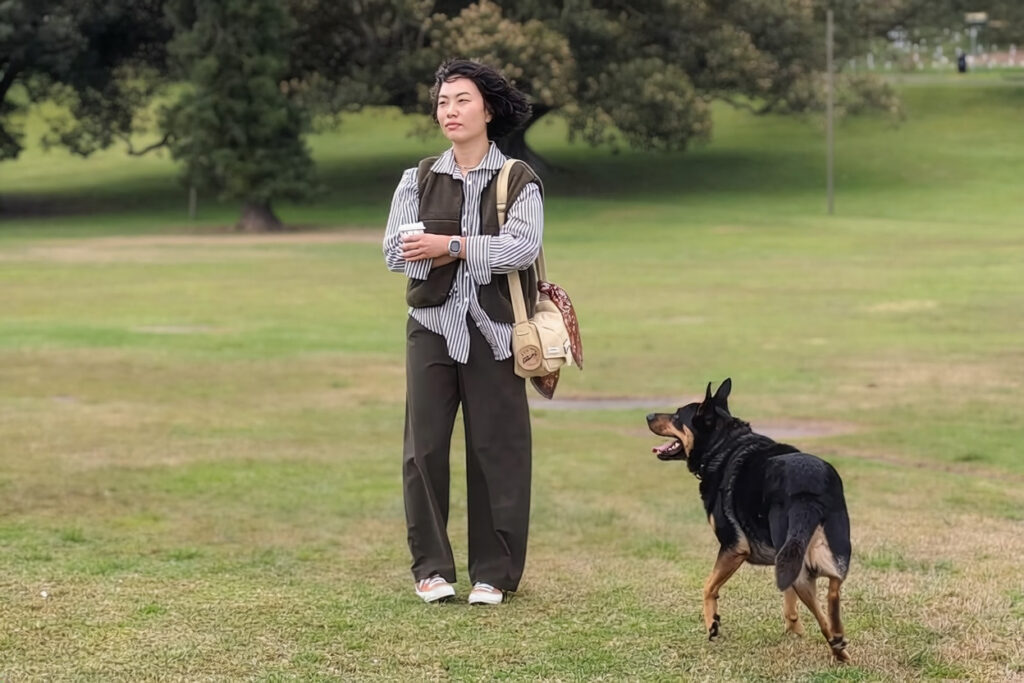
What if the best way to get a dog to leave you alone was to do almost nothing at all? Here’s exactly what that looks like and why it works — like magic.
If you're scared of dogs, being approached by an excited off-leash dog can be a terrifying experience. Your heart races, your body tenses and you just want the dog to go away.
Those reactions make complete sense. But many of the things fear pushes you to do — running, backing away, shouting, keeping your eyes locked on the dog — tend to make dogs more interested in you, not less.
There's a simple technique we teach clients, that works by changing how dogs feel towards you. We call it the magic statue.
In this article, we explain why dogs respond the way they do to fearful people, clear up two common myths, and show you how to use the magic statue in the park, at a friend's house and on the footpath.
[contents]
Do dogs target people who are scared of them?
Many people who are scared of dogs feel as though dogs single them out. That feeling isn't imaginary, but the reason is not that dogs pick on frightened people.
Dogs may be able to pick up the smell of human fear, but if anything this makes them less likely to approach, not more likely.1 What seems to matter much more is how fear makes us move.
In one study, people who scored lower on a measure of emotional stability were more likely to have been bitten by a dog at some point in their lives.2 The study couldn't prove cause and effect, but one interpretation is that they tended to behave more erratically around dogs.
Fear often makes people do things that attract dogs' attention and increase their arousal: sudden movements, high-pitched sounds, staring, freezing and then bolting. To a dog, these signals can be exciting, or even threatening. A person who walks calmly past with their attention elsewhere gives a dog very little to respond to.
That's critical. If what you do matters more than what you feel, then you can change how a dog responds to you, even while you're scared.
Should you show a dog who's boss?
Another common piece of advice is to 'show the dog who's boss': stand tall, stare it down and refuse to back off. This comes from dominance theory — the idea that dogs are always trying to climb a pack hierarchy, and that people need to assert themselves as the 'alpha'.
The idea largely came from early studies of unrelated wolves kept together in captivity. Research on wild wolves later found that a typical pack is simply a family, with the parents guiding the group, rather than a group competing for rank.3 Researchers studying domestic dogs have found little evidence that dogs are driven by a desire for status over people. Their behaviour, including aggression, is better explained by what they have learned and by how much they value what's at stake.4
Trying to dominate a dog can also backfire. In a survey of dog owners attending a veterinary behaviour service, staring a dog down provoked an aggressive response in about 30% of the dogs it was tried on.5 A dog that is already worried about you is unlikely to feel less worried when you challenge it.
Why running, screaming and staring make things worse
When you're scared, your body's fear alarm takes over and pushes you to run, fight or freeze. These reactions are designed to protect you, but around dogs they often send exactly the wrong message.
A dog's behaviour depends largely on how it feels. Each of these common reactions tends to make a dog feel more excited or more threatened.
Running away. Chasing things that move is a deeply ingrained part of dog behaviour.6 A running person can trigger that urge to chase, even in a friendly dog — and very few people can outrun a dog.
Backing away. Stepping back slowly feels safer, but it usually means moving while watching the dog closely. Movement invites the dog to follow, and you can't see where you're stepping.
Making eye contact. It's natural to keep your eyes on something you're afraid of. To a dog, though, a steady stare can look like a challenge. In one experiment, a stranger approached dogs either in a friendly way, walking normally and talking, or slowly and silently while staring into the dog's eyes. The dogs responded very differently to the two approaches, and the staring approach was the one that brought out wary and defensive reactions.7
Screaming, squealing or waving your arms. Loud, high-pitched sounds and sudden arm movements can turn the encounter into a game for an excited dog. For a nervous dog, they can be alarming.
Pushing the dog away. If a dog jumps up, pushing it off with your hands is an understandable reflex. But many dogs find physical contact with people rewarding,8 and hands moving around a dog's head can look like an invitation to play.
The magic statue: how to get a dog to leave you alone
The magic statue is a simple way to make yourself as boring and non-threatening to a dog as possible. It has 4 steps.
Stand still, side-on. Stop moving and turn slightly to the side. Facing a dog head-on can feel confrontational and turning your back means you can't see what's going on.
Fold your arms across your chest. This keeps your hands still, close to your body and away from the dog's face. It also removes the movement that can invite play.
Stay quiet. No talking, shouting or squealing. If you can, exhale slowly through your mouth to stay focused and in control.
Look away. Rest your eyes on something else, like the ground or a tree, rather than the dog. You can still keep track of the dog out of the corner of your eye.
Then wait. Most dogs will sniff, lose interest and wander off within a short time, though it can feel a lot longer in the moment.
Try not to step back or pull your leg away while the dog is sniffing, as this can make the dog more interested or excited, which can quickly escalate.
Once the dog has moved on, walk away at a normal pace. If the dog returns, repeat the statue.
Why it works
The magic statue works because it changes how the dog feels about you, which ultimately determines how it behaves towards you.
An excited dog has nothing to play with. Excited, playful dogs are drawn to movement, noise and attention. A person who stays still, quiet and looking elsewhere offers none of those. Dogs learn quickly from what pays off,4 and waiting around for a reaction that never comes soon gets boring.
A worried dog has less to fear. A dog that barks or rushes at you is usually perceiving you as a threat. Staring, facing a dog head-on and sudden movements are all signals that can increase their sense of danger.5,7 When you take them away, the dog has less reason to feel defensive. In one study, dogs that had reacted defensively to a stranger's threatening body language became friendly again once the stranger switched back to friendly behaviour.9
Nothing moves, so nothing triggers a chase. Many dogs have a strong instinct to chase things that move fast.6 A still person gives a dog's chase instinct nothing to work with.
You don't have to feel calm to do it. The magic statue is about calm behaviour, not calm feelings. Your heart might be pounding and your mind racing, and that's OK. The dog responds to what it can see your body doing, not to how you feel on the inside.
No single technique works for every dog in every situation, but the magic statue is extremely effective because it's based on what research shows about how dogs respond to people's movement, gaze and posture, and is the best option for dealing with an encounter you can't avoid.
Using the magic statue in everyday situations
An off-lead dog in a park or on the street. Ignore the dog unless it is clearly showing an interest in you and heading your way. If it does approach, don't try to run. Stop and use the magic statue. Be patient and let the dog satisfy its curiosity. Once the dog has lost interest, calmly walk away.
A dog at a friend's house. Excited dogs often rush to the door to greet visitors. If you can, ask your friend before you arrive to keep their dog on a lead or in another room until you've settled in. If the dog greets you anyway, become a statue and let it sniff. Many dogs settle far more quickly when the visitor doesn't react.
An on-lead dog on the footpath. You don't usually need the full statue here. Step to the side to give the dog some space, turn slightly side-on, look elsewhere and let it pass. Keep your hands still and close to your body.
If a dog jumps up on you. Stay a statue. Keep your arms folded, turn side-on to the dog, and keep looking away. Avoid pushing the dog off or raising your voice, which can make jumping more fun. Most dogs give up once jumping stops getting a reaction.
A favourite dog trainer's saying is "train for the moment, not in the moment". In other words: develop your skills in a safe and predictable context, not under the pressure of the moment in a critical situation.
Find a calm dog with a handler you trust to practise using the magic statue with, until you feel ready to meet more active dogs in less controlled environments.
Teaching your child the magic statue
Children who are scared of dogs are especially likely to run, squeal or wave their arms, so it helps to practise the magic statue before they need it.
There's good reason to think practice makes a difference. In a Sydney trial, children aged 7 to 8 had a single 30-minute dog safety lesson that included practising a protective way of standing. Later, when they came across an unfamiliar dog tied up in the playground, 9% of those children patted it, compared with 79% of children at schools without the lesson.10
To practise at home:
Make it a game. Call out 'magic statue!' and have your child freeze, fold their arms, look away and stay quiet until you say 'unfreeze'. Take turns being the statue and the dog.
Keep it light-hearted. The aim is to give your child a tool that gives them confidence, not to push them to endure distress.
Practise in different places, like the backyard, the park and the shops, so the skill travels with them. Start with predictable, controlled surroundings.
Set them up for success. Don't prompt your child to use the magic statue when they're too scared to stay still. Step in to take control of the situation if needed, to prevent interactions that your child doesn't consent to.
Adapt it to your child. Some children, including many autistic children, find keeping still hard, or move their bodies to manage big feelings. That's OK. Short, frequent practice in calm moments helps, and the steps can be adjusted — for example, squeezing their hands under their arms or counting silently while they look away.
For more ideas, see 11 things you can do to help your child overcome a fear of dogs and why your autistic child's fear of dogs makes perfect sense.
A tool for the moment, not a cure
The magic statue can help you feel more in control when you meet a dog. But it's a way to get through an encounter, not a way to overcome a fear of dogs.
If you find yourself avoiding parks, turning down invitations to friends' homes or scanning every street for dogs, fear is still making the decisions. Relying on any strategy to feel safe can even keep fear going, because your brain never gets the chance to learn that you can cope without it.11
Exposure therapy is the most effective treatment for phobias.12 It helps your brain learn new things about dogs, step by step, at a pace you choose. If being near a real dog feels like too much for now, virtual reality exposure therapy can be a gentler place to start.
If fear of dogs is getting in the way of your life or your child's, a Roadmap session is a good first step. It's a 90-minute telehealth consultation where we talk through your fear, what you'd like to be able to do, and map out a plan to get there.
Dogs don't single out people who are scared of them, but they do respond to the things fear makes us do. Running, backing away, staring and screaming tend to make dogs more excited or more threatened, and trying to 'show a dog who's boss' can make things worse.
The magic statue — standing still side-on, folding your arms, staying quiet and looking away — makes you boring and non-threatening. Excited dogs usually lose interest, and worried dogs have less reason to feel defensive.
It's a useful tool for the moment. If fear of dogs is limiting your life, exposure therapy can help you change the fear itself.
[signature]
References
- D'Aniello, B., Semin, G. R., Alterisio, A., Aria, M., & Scandurra, A. (2018). Interspecies transmission of emotional information via chemosignals: From humans to dogs (Canis lupus familiaris). Animal Cognition, 21(1), 67–78.
- Westgarth, C., Brooke, M., & Christley, R. M. (2018). How many people have been bitten by dogs? A cross-sectional survey of prevalence, incidence and factors associated with dog bites in a UK community. Journal of Epidemiology and Community Health, 72(4), 331–336.
- Mech, L. D. (1999). Alpha status, dominance, and division of labor in wolf packs. Canadian Journal of Zoology, 77(8), 1196–1203.
- Bradshaw, J. W. S., Blackwell, E. J., & Casey, R. A. (2009). Dominance in domestic dogs – useful construct or bad habit? Journal of Veterinary Behavior, 4(3), 135–144.
- Herron, M. E., Shofer, F. S., & Reisner, I. R. (2009). Survey of the use and outcome of confrontational and non-confrontational training methods in client-owned dogs showing undesired behaviors. Applied Animal Behaviour Science, 117(1–2), 47–54.
- Coppinger, R., & Coppinger, L. (2001). Dogs: A startling new understanding of canine origin, behavior, and evolution. Scribner.
- Vas, J., Topál, J., Gácsi, M., Miklósi, Á., & Csányi, V. (2005). A friend or an enemy? Dogs' reaction to an unfamiliar person showing behavioural cues of threat and friendliness at different times. Applied Animal Behaviour Science, 94(1–2), 99–115.
- Feuerbacher, E. N., & Wynne, C. D. L. (2015). Shut up and pet me! Domestic dogs (Canis lupus familiaris) prefer petting to vocal praise in concurrent and single-alternative choice procedures. Behavioural Processes, 110, 47–59.
- Gácsi, M., Vas, J., Topál, J., & Miklósi, Á. (2013). Wolves do not join the dance: Sophisticated aggression control by adjusting to human social signals in dogs. Applied Animal Behaviour Science, 145(3–4), 109–122.
- Chapman, S., Cornwall, J., Righetti, J., & Sung, L. (2000). Preventing dog bites in children: Randomised controlled trial of an educational intervention. BMJ, 320(7248), 1512–1513.
- Craske, M. G., Treanor, M., Conway, C. C., Zbozinek, T., & Vervliet, B. (2014). Maximizing exposure therapy: An inhibitory learning approach. Behaviour Research and Therapy, 58, 10–23.
- Wolitzky-Taylor, K. B., Horowitz, J. D., Powers, M. B., & Telch, M. J. (2008). Psychological approaches in the treatment of specific phobias: A meta-analysis. Clinical Psychology Review, 28(6), 1021–1037.
